 THRACK
Learn to fight
in the ruins
Thrackdown is a free post-apocalyptic skirmish game for two players, usually played with a small warband of miniatures on each side.
If you're new to Thrackdown, start with Game 1: Loot & Scoot, then follow the three-game introduction as it builds towards a full warband. It introduces the rules a few at a time, so you can get models on the table without learning the full game first.
Printing at home? Get the print-friendly version (lighter on ink)
D6 based, Alternating activations, 4 fighters to start, roughly 6 to 8 in a full warband
Learn the Game in Three Battles
The three-game introduction adds the rules in stages. Each one adds another part of Thrackdown, so you can learn by playing rather than trying to remember the entire ruleset before your first battle.
Quickstart Battle
Start with four fighters and the core rules you need to move, shoot, fight and take objectives. Several campaign and advanced rules stay out of the way for now.
Play your first game →Full Rules Battle
Grow your Quickstart Warband to around 150 Thracks and switch to the full fighter profiles. Game 2 brings in the full faction rules, faction Momentum Surges and every weapon Trait.
Read the walkthrough →Full Thrackdown
Move up to a normal 200-Thrack warband and choose your own fighters and equipment. From here you are playing Thrackdown with the full rules and can start a campaign if you want to keep the warband going.
Read the walkthrough →The Five Fighter Stats
Every fighter has five core stats: Movement, Accuracy, Defence, Fight and Hit Points. Together they tell you how far a fighter can move, how well they shoot, how difficult they are to hit, how capable they are in melee and how much damage they can take.
You do not need a long profile to work out what a fighter is good at. Most of what you need during a battle comes back to these five numbers.
The shot goes wide. Ruins eat bullets, and open ground is a promise you make to the enemy.
No blood drawn, but the target flinches and gains a Nerve Token. Fear is damage too.
The target gains a Nerve Token and you roll on the Impact Table to see how badly it lands.
A natural 6 always inflicts a Nerve Token, even if the shot would otherwise fail.
Alternating Activations
Thrackdown uses alternating activations. One player activates a fighter, then the other player activates one of theirs. Play continues back and forth until every fighter has activated, then the round ends and a new one begins.
That means your opponent is rarely sitting around while you move an entire warband, and every activation can change what you planned to do next.
Start Phase
Resolve initiative (roll off, adding your Momentum), scenario rules, faction rules, and ongoing effects.
Activation Phase
Players alternate activating fighters, one at a time, two actions each. The heart of the game.
End Phase
Clear markers, remove a Nerve Token from every model, score objectives, and check whether the battle ends.
Two actions, spend them well.
Most fighters get two actions when they activate. How you spend them depends on what is happening on the table. You might move and shoot, aim before firing, climb into a better position, interact with an objective or use both actions getting somewhere quickly.
The actions themselves are simple. The important part is deciding which two matter most right now.
| Move | Move up to your M stat in inches. |
| Shoot Max once | Make a ranged attack against a visible enemy or object. |
| Fight Max once | Engage an enemy in melee combat. |
| Aim | Gain +1 Accuracy to your next Shoot action this activation. |
| Take a Breath | Remove 1 Nerve Token from this model. |
| Stabilise | Revive a Downed ally within 1" on a 4+, or remove a negative status effect. Self-Stabilise succeeds on a 5+. |
| Interact | Work objectives, doors, consoles, and loot. Often needs a set score (normally a 3+). |
| Eliminate | Remove a Downed enemy within 1". |
| Snap Fire | Once per round, an unactivated fighter may interrupt an enemy Move action in its line of sight: Shoot at −1 ACC from any point of that move. Uses its Shoot and 1 of its 2 actions. |
Nerve and Momentum
Two systems sit alongside the basic action rules and give you more ways to influence a battle than simply dealing damage.
Nerve represents the pressure building on individual fighters. Taking fire, seeing allies go down and other battlefield effects can add Nerve Tokens, making it harder for that fighter to keep doing exactly what you want.
Momentum belongs to the warband as a whole. You gain it during the battle and can spend it on extra options when you need to recover from a bad roll, push an attack further or react to an opportunity.
Neither system replaces the basic rules. They give you more decisions once the battle starts getting messy.
Nerve
Combat is relentless. Fighters flinch, panic, or freeze, represented by Nerve Tokens: gained when hit by any attack, when an ally within 5" goes down, or when losing a melee, even if no damage is dealt.
At the start of an activation, a fighter with tokens takes a Nerve Test: roll 1D6 and beat the number of tokens, or the activation ends on the spot. A 6 always passes. A 1 always fails.
Leaders steady those around them, and a moment to breathe can clear a head. But pile enough fear onto an enemy and they will break without a single wound.
Momentum
Bold play fills your warband's shared Momentum Pool: holding objectives, charging into contact, leaping gaps, jumping down levels, or sprinting flat out. Success is not required. Daring is.
Spend it at any time on Surges:
| Surge | Effect | Cost |
|---|---|---|
| Dash | +1 M this activation | 1 |
| Ignore Cover | Strip the target's cover benefit | 1 |
| Do Over | Reroll a single die | 2 |
| Opportunity Attack | React when an enemy breaks off from melee | 2 |
| Shrug Off | Remove D3 Nerve Tokens | 3 |
| Extra Action | A third action this activation | 3 |
Faction rules also add their own Momentum Surges.
Building a Full Warband
The Quickstart begins with four fighters, but a normal Thrackdown warband is built to 200 Thracks and will usually contain around 6 to 8 fighters, depending on the faction and equipment you choose.
Every warband needs a Leader, and Core fighters form the backbone of the roster before you start adding Specialists and more unusual units. Each faction approaches that structure differently, so two 200-Thrack warbands can look and play very differently.
You can build the roster yourself from the faction rules, or use the free Warband Builder to keep track of costs and composition limits for you.
Leader required. Every warband needs at least one Leader to hold it together.
Core before Specialists. You cannot field more Specialist fighters than Core fighters.
Juggernaut limit. One hulking monster, machine, or champion at most.
Named units. Unique characters are one per warband unless stated otherwise.
If you carry the same warband into a campaign, those fighters can gain XP, improve, pick up new equipment and carry injuries from one battle into the next.
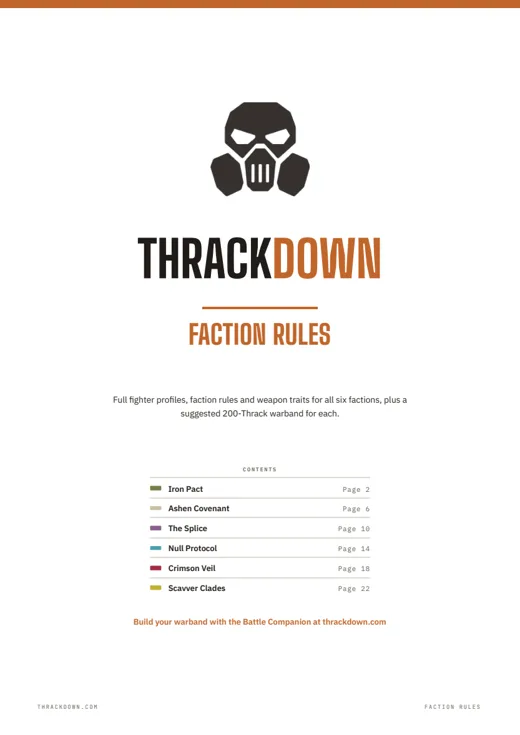
Get the Full Faction Rules
Take your warband beyond the Quickstart. Get the full rules for all six factions sent to your inbox, with the option to join the Muster List for new units, scenarios and rules updates.
Everything you need to play
Quickstart Pack
Everything needed for the first game: Start Here, Quickstart Guide, six Quickstart Warbands and Loot & Scoot.
Get the Quickstart Pack Free Online ToolWarband Builder
Build and manage a warband, track Thracks, and use the live battle tools while you play.
Open the Warband Builder Rules & ReferencesPlayer Resources
Quick-reference material for the table, including the Cheat Sheet, Starter Armoury and other downloadable rules resources.
View Rules & DownloadsCurrent version: Open Alpha
Read the changelog and errata
Before you ask
Is Thrackdown free?
The rules are free, and they will stay free forever. Official miniatures and printed books are planned as optional extras for anyone who wants to support the game.
Is Thrackdown print-and-play friendly?
Can I use any miniatures in Thrackdown?
How many models do I need to play?
How long does a game take?
Does Thrackdown support campaign play?
The campaign system is part of the Open Alpha, so some details may still change as it is tested and more people play through longer campaigns.
Will the rules change during the Open Alpha?
How do I report a rules problem or give feedback?
You can also join the Thrackdown Discord to discuss the rules, share your warband or talk through something you encountered during a game. Feedback from the Open Alpha is used when reviewing future rules updates.
The rules are free. The fights are not fair.
Grab four miniatures, choose a Quickstart Warband and play Loot & Scoot. If you survive that, there is plenty more waiting.